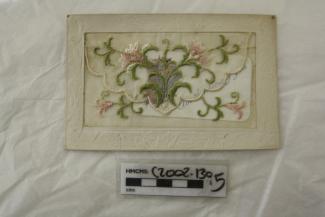
Embroidered Silk Postcards
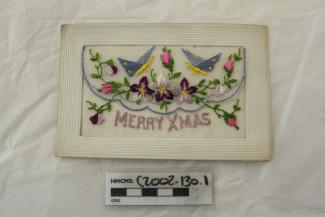
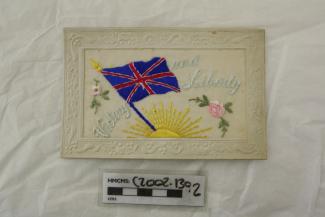
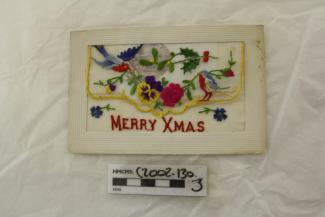
Embroidered silk postcards, or 'WW1 Silks', became a popular souvenir among British soldiers who would send the postcards to loved ones along with letters. Due to this, many postcards seem to be blank or lacking information when simply, they may have just become separated from the letter. Despite this, the good condition of these cards indicates their significance and sentimental value to the recipient.
Design
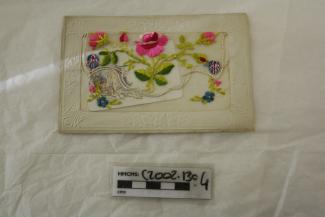
Most designs used a range of brightly coloured threads and symbolic motifs to convey meaning such as horseshoes for luck. Alternatively, designs also focused on local landscape features, towns and regimental emblems. These designs aimed to contrast the soldier's experience in the trenches and reassure the recipients. Lastly, some postcards included a ‘silk pocket’ in which pre-printed cards were added such as ‘I’m thinking of you’ or ‘To my loving sister’ (C2002.130.4 and C2002.130.5).
Production
While there popularity was extremely high during the First World War, embroidered postcards already existed and were a popular gift in France from the 1900s. Consequently, embroidered postcards were usually machine woven allowing for more complex images in contrast to the more time consuming hand embroidery process. One common assumption is that these postcards were created by French and Belgian women to raise additional income. While this likely occurred, given the vast number of postcards, pre-existing technology like Josué Heilmann's hand embroidery machine, and the economic potential, these cards are more likely attributed to companies who could mass produce these postcards.
Private Evan Frank Button (1890-1916)
Our records indicate that these postcards were sent by 'Frank Button, died 1916'. Based upon this, Private Evan Frank Button was identified as the most likely owner and sender of these cards. Private Button served in the 13th Battalion of the Welsh Regiment, British Army and his service number was: 18252. In 1910, Evan Frank Button married Sarah Ann Hier and they would have three children: Frank, Emily Muriel and Glenys Rose.
Following the outbreak of the war, Evan likely enlisted at the formation of the 13th battalion in Cardiff on the 23rd October 1914. This was likely a local 'Pals' Battalion as part of Kitchener's 'New Army'. Prior to landing at Le Havre, France in December 1915, the 13th Battalion are recorded as being at Morn Hill transit camp, Winchester in August 1915. During Evan's deployment in France, he was likely involved in the famous attack by the 38th Welsh division at Mametz Wood, 10th July 1916, where 12 officers and 350 other ranks were killed. After such devastating loses, the battalion were withdraw to refit and absorb reinforcements. In September 1916, Evan with the 13th Welsh were based at Ypres Salient and working under the direction of the Royal Engineers to work on the defences at Yser Canal. Here, it is probable that Evan's was wounded and sent to Wimereux hospital center where he died on 9 October 1916. Sadly, this suggests that these were the last Christmas cards that Button would send home with the harsh reality of war contrasting the images of light, hope and optimism that the postcards symbolised. He is buried at the nearby Wimereux Communal Cemetery, France.
These embroidered postcards were audited as part of the Data Hunters and Story Gatherers project funded by the National Lottery Heritage Fund. A special thanks to David Whithorn for research Evan's life and helping us to tell his story.