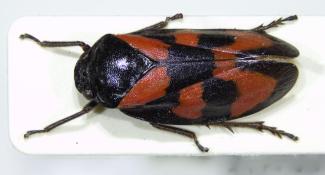
With a length of about 10mm, the Red-and-black Froghopper, Cercopis vulnerata, is one of the largest, and most identifiable, of a family of ‘True bugs’ known as Spittlebugs. The adult froghopper uses its beak-like mouthpart to penetrate and feed on the juices of grasses and low-growing plants present in meadows and woodland areas. As well as being capable of flight, when disturbed the adult can rapidly extend its back legs to be capable of leaping a reputed 70 centimetres into the air.
The young bug, or nymph, lives underground where it sucks sap from the roots of grasses and other plants and then extrudes it from its anus to form a frothy mass (hence the term ‘spittlebug’). This foam forms a nest around the nymph which offers protection from both desiccation and predation from ants and parasitic wasps. Because the nymphs hatch in the spring from eggs that have overwintered, the timing more-or-less coincides with the arrival of cuckoos – so giving the foam the common name of ‘cuckoo spit’! The young bug develops within the foam and, when fully grown, it emerges from its nymphal case as a winged adult.