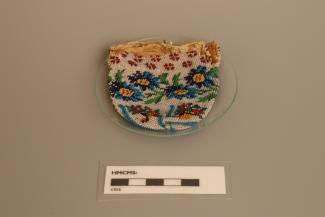
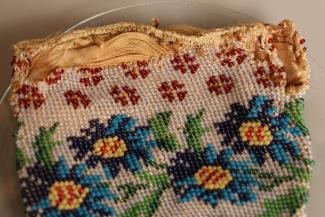
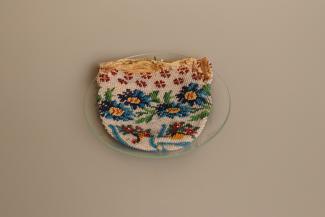
A small beaded bag, which according to family tradition, was worked on by Jane Austen herself. It has a golden-brown inner silk lining and a lighter colour thread across the top. Little holes are formed from the lighter coloured thread which are now exposed due to the fragile nature of the bag. These tiny holes are the ones used to knit the beads into the bag. The pattern of beads adorned throughout are predominantly white, which serves as a background. At the top there are red beads that become petals to an orange bead in the centre of them. Underneath, there is a larger pattern of forget-me-nots with leaves, adorned with various shades of blue and green, to help create artistic shading and a naturalistic effect to them. Finally at the bottom of the beaded bag, there is a repeated J-shaped flower in basket design with red flowers and green leaves. At the centre bottom of the beaded bag, there is a light blue swirl pattern that makes it way up and splits between the flower in basket design. This is where Jane would have most likely started when working on her beaded bag.
This bag, along with two other objects, was purchased into the collection from Jane Austen’s great-niece, Edith Stokes. All three objects were bought for £200, with £100 from the Winchester Committee and another £100 through subscriptions.
From the 1750s onwards, middle- and upper-class women would spend their leisurely time crafting, and the most coveted creation was the beaded purse. Patterns and instructions to make these were found in many Ladies and Fashion Magazines of the time, which is where Jane most likely found the pattern for this small bag. The main material the beads were made from was glass, and these beads were fastened onto silk thread with extremely fine knitting needles of 1mm diameter or less. The beads were knitted in a round with five needles, similar in style to stocking knitting. With each knitted mesh, a bead was shifted onto the thread and knitted into the mesh. Once a row was finished, the end was often marked with a piece of paper or large bead that was later removed.
During an era with no distractions from phones, TVs and online content, making beaded bags was a great past time which was very time-consuming for the genteel woman. The pattern of a beaded bag shows a slight lateral offset that was most noticeable at the side edges. As a result, beaded bags were washed after knitting and then were stretched out wet to dry.
There were various options for the design for the upper edge and closure of the bags, with the most popular being a drawstring, where the cord was pulled through rings or via a crocheted or sewn-on flipped edge. The metal clasp, as seen on LH868.4, came into fashion later. Due to the fragile condition of beaded bags, how this purse was finished has been lost to time. What it does show, however, is that Jane Austen was a master craftsman of the beaded bag.
This item is currently on display at the Winchester City Museum
With thanks to The Bead Society of Great Britain for their help in researching this object.
This object was audited and researched as part of the Heritage Funded Data Hunters and Story Gatherers project.