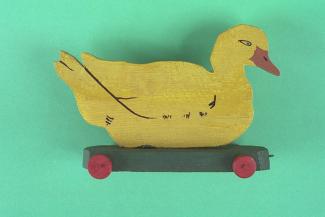
This child’s wooden pull-along toy duck probably dates from the 1930s-40s. It is painted yellow, with a red/orange beak. Other features, including the eyes and wings, are picked out in black. It seats on a green rectangular wooden base with four red wheels and an attachment for a cord to pull it along.
Throughout history toys have often had an educational element to them, whether it be helping boys to develop skills for later work roles or girls to manage a household and care for a family. However, this toy duck does not appear to follow this model and is not aimed at a specific gender. It appears to be solely for pleasure and imaginative play.
Archaeologists have discovered some of the earliest examples of wooden pull-along toys (such as a toy horse) buried in Ancient Egyptian pyramids. In Medieval Europe handmade wooden toys were popular and were often passed down through families. Industrialisation and mass production saw all toys become cheaper and accessible to a wider market. However, the popularity of wooden toys had declined by the middle of the 20th Century, as plastic replaced wood (and other materials) as the most common material for toy-making.