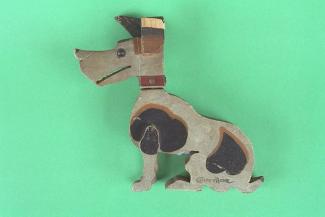
Dated to around the 1930s to 1940s, this wooden toy dog has a white base coat. Hand-painted onto the body and ears are black and tan patches and a red collar. It is carved in a sitting position, and with an appealing facial expression and pricked-up ears, the overall effect is of an alert, cute, small dog, suitable for a young child. The dog has a moveable head giving it an extra dimension as a plaything.
Unlike many toys, both in the past and nowadays, this is not aimed at a specific gender. It could encourage imaginative play allowing its owner to have the fun of a dog without the fuss of caring for a real one!
Wooden toys been around since at least the Ancient Egyptian era: archaeologists have found wooden animals (some with moving parts) buried in pyramids. During the Medieval period in Europe handmade wooden toys were popular and were often passed down through families. Industrialisation and mass production saw all toys become cheaper and more accessible. However, by the middle of the 20th Century, the popularity of wooden toys had declined as plastic replaced wood (and other materials) as the most common material for toy-making.