History
For Native Americans, quill work was considered as a privileged and sacred craft traditionally by women. To add, quill work is not only used in clothing but also used as a decorative addition to adorn commonplace objects such as cups or tools.
After collecting the porcupine quills, the quills would then be dyed using locally sourced plants, for example wild sunflowers to make the quills yellow. Eventually, through trade, aniline dyes became widely used in place of plants as this was easier and more efficient at producing brighter colours. Finally, following the introduction of glass beads around the mid 1800s, bead work became increasingly popular and was used more often than the time intensive traditional quill work.
Design
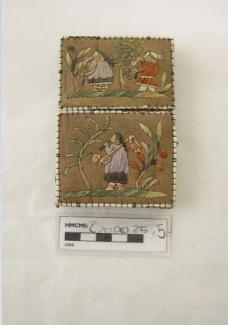
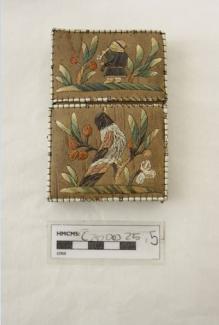
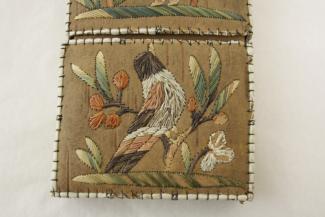
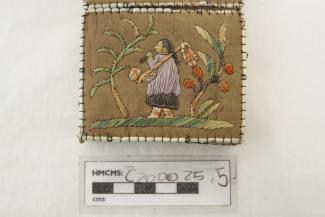
The box consists of four designs, three including people and one of a bird. All three people are carrying what is assumed to be a pipe or flute while walking through their environment. Considering the yoke with a checkered pattern, plain clothing, and lack of visible hunting equipment, it is permissible to say that these scenes represent foraging. Based on the bird's stance, potentially a robin or thrush, the bird is likely to be singing which may be attracting the foragers closer to the red berries. Lastly, the box is stitched with black thread at the edges connecting the leather to the wood will also defining the lid and the box itself.
This object was audited and researched as part of the NLHF Data Hunters and Story Gatherers project.

This object was audited and researched as part of the NLHF Data Hunters and Story Gatherers project.