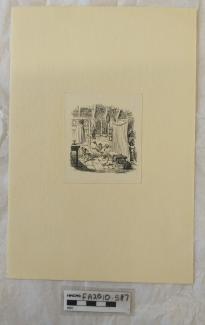
A small black and white sketch printing placed on a cream board depicting a scene from ‘The Elves and the Shoemaker’ which was completed by caricaturist George Cruikshank most likely in the 1820s. Later editions of the book which this artwork features in are dated to 1839 and 1876. The sketch is of a scene in a workshop, with two elf-type figures at the centre, dancing with clothes made specially for them, and an older couple hidden behind a curtain. The workshop features a work desk and tools, with the older couple on the right side of the sketch. A background of finished, or partly finished, shoes forms the background of the sketch.
The scene featured from the story of The Elves and the Shoemaker is perhaps one of the last of that story, wherein the shoemaker and his wife have previously discovered the elves assisting them with their shoemaking. As a gratitude, they make the clothes and shoes that the elves are seen dancing with, in the sketch. The sketch was featured in a novel known as German Popular Stories. This was a translation of the Grimm brothers’ Kinder- und Hausmärchen (Children and Household Tales) by English author Edgar Taylor. Initially, Taylor had worked with Cruikshank alone on his novel. But the second edition also featured illustrations from Ludwig Emil Grimm, the brother of Jacob and Wilhelm Grimm (the Brothers Grimm).
This object was audited and researched as part of the Heritage Fund Data Hunters and Story Gatherers project.