Design
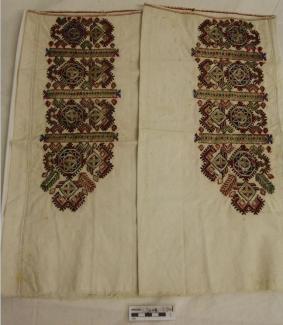
In 1964, the Department of Textiles at the Victoria and Albert museum identified the sleeves as having an Eastern European style, likely Romanian in origin, and dating the sleeves to between 1880-1920. Although, given the proximity and connections with neighbouring countries, cultures, and regions, artistic motifs and styles were frequently shared, adopted, and adapted making a precise origin uncertain.
Traditionally, embroidered fabric was considered a sacred garment which emphasised an individual's values and virtue, making the practice of embroidery and weaving sacred. Overtime, embroidered garments became more common and inspired by fashion trends yet, the geometric design and symbolism still remained prevalent. Firstly, the red and green outlined wheat sheaf is known to represent peace, prosperity and growth. Similarly, the wheel inlaid with a cross (gold diamond shape with a black outline) symbolises peace and Christianity. Next, the red ram horns, which look like a stretched 'W', demonstrates power and strength. Together, by wearing this garment, the individual is expressing their relationship with agriculture and emphasising prosperity through religion. Ultimately, separate to the geometric motifs, there must be consideration of artistic creativity and personal preference in relation to the selection of colours and the overall design.
This object was audited as part of the NHLF Data Hunters and Story Gatherers project.