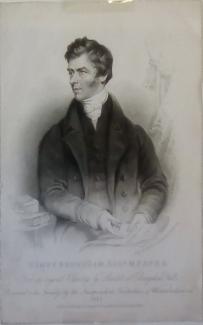
A print of an engraving of Henry Brougham Esq., dressed in a dark waistcoat and overcoat with a folded cravat. A curtain is draped to his right, and to his left is a table stacked with books. He holds ‘A Bill For preventing Abuse of Charities’ in his hands. Printed text at the bottom left of the engraving reads ‘Engd on steel by R. Fenner. Pater Noster Row.’ The inscription below the portrait reads: ‘From an original Painting by Lonsdale at Brougham Hall. Presented to his Family by the Independent Freeholders of Westmordane in 1821. London. Published by Knight & Lacey. Pater Noster Row. May 28 1825.’
Henry Peter Brougham, 1st Baron Brougham and Vaux, PC, FRS (19th September 1778 –7th May 1868) was a Scottish lawyer, politician, and reformer. He became the legal adviser to then-Princess Caroline of Brunswick in 1812, and defeated the Pains and Penalties bill in 1820. As a member of the left-wing Whig party he is known for his legalr reforms, and the promotion of education for the working-class, as well as his role in passing the Slavery Abolition Act (1833). He was co-founder of the third iteration of The Edinburgh Review (1802), and the University of London (1825-28), the first nondenominational institution of higher learning. His advocation for equal rights is also shown through the delivery of a six hour speech in the House of Commons in 1828 that set the reform of the British legal system into motion. Another of his speeches is often quoted by modern defence lawyers regarding the fervent advocation for their clients.
In the print, Brougham holds ‘A Bill For preventing Abuse of Charities’, a 129 page letter written to Samuel Romilly, a fellow lawyer and reformer, and then-member of parliament for Arundel. Having become the de facto Parliamentary leader for education in 1815, Brougham focussed on the mismanagement of charities, conducting surveys that revealed the depth of issues within the sector. Some of these include a lack of trustees, significant underfunding, widespread nepotism, and if auditing was present, it was lazy. Further issues included maladministration of charitable funds given for educating the poor, and inadequate provision of schooling. Brougham’s bill advocated for stiffer legal structure to prevent such corruption within charitable organisations, and the establishment of schoolhouses to make up for the lack of space.
The bill is referenced within the 1818 publication ‘Vindiclæ Wykehamicæ; OR, A Vindication of Winchester College’ by the Reverend W. L. Bowles. This reply to the strictures on Winchester College includes the refusal to submit the College’s accounts and statutes due to ‘moral and religious difficulty’. Ultimately, due to insistence from the Anglican bishops, six schools were excluded from Brougham’s official investigations from the outset, including Winchester.
In 1833, the findings of Brougham’s investigation justified the first state intervention into English and Welsh education, leading to the construction of new schoolhouses, and the removal of religious restraints. In total 2,100 trusts were reformed or renovated. 400 of these trusts were referred to the Attorney General for prosecution.
This object was audited and researched as part of the Heritage Fund Data Hunters and Story Gatherers project.