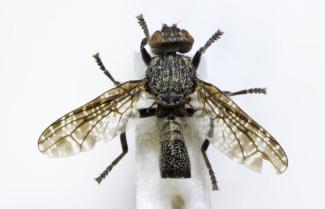
From May to October, Platystoma seminationis can be observed around shady vegetation alongside hedgerows and woody edges where they feed on the nectar and pollen of spurge (Euphorbiaceae) plants; they are also attracted to overripe and fermenting fruits.
With its attractively mottled wings, Platystoma seminationis is commonly called a ‘Signal fly’ in the UK and a ‘Kiss fly’ in the USA. Both names are apt and refer to their elaborate courtship behaviour. The male fly flutters his wings as a visual signal to communicate with females of the same species (it is thought that the movements, together with the wing pattern are species-specific). Once the male encounters a female, they circle sideways around each other before ‘kissing’ by pushing their sucking mouthparts together for an exchange of oral fluids (their family name ‘Platystomatidae’ is Greek for ‘broad mouth’).
Eggs are laid in decaying vegetable material on which the emerging larvae develop and feed. The pupal stage is spent buried in the same material before metamorphosing into adults.