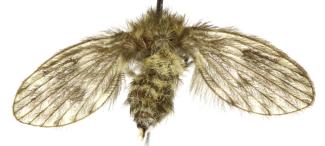
The family Psychodidae consists of small flies with a multitude of common names depending on appearance or their location! Because their wing veins and bodies are covered by hair-like scales they may be called ‘moth flies’, or ‘owl midges’ because the way their wings are held over their body suggests a fluffy, owl-like appearance.
This specimen (which has not been identified to species) was found in a Hampshire woodland where it may have been breeding in wet material present in ditches, in tree holes, or in decaying, organic matter like rotting vegetation. Some species, however, are present in drains (drain flies), sewage filter systems (sewer and filter flies), and even in the sludge and slime accumulating in the water-traps of bathroom basins (bathroom flies)!
Adult flies, which have relatively weak wing muscles, can only make short flights, and usually move around by hopping and running – so they rarely travel far from the location where they hatched and developed. Eggs are laid in damp environments containing the bacteria and other microorganisms on which the larvae will feed. Hatching occurs within a few days at 21˚C, and the emerging larvae develop in about a fortnight before entering a two-day pupation stage.