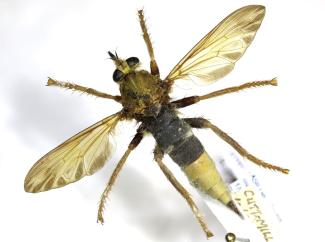
With a body length of 25mm, the Hornet robberfly, Asius crabroniformis, is one of the largest flies in the U.K.. Although robber flies are fierce predators of other insects, ironically the black-and yellow colouration of the Hornet robberfly, as its name suggests, mimics that of an actual hornet and this helps protect it from being eaten by other predators!
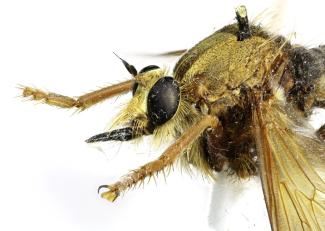
The Hornet robberfly may be found on heathland and unimproved or semi-improved grassland in southern England, resting on piles of drying-out animal dung and watching for any passing insect – a variety of insect species can be taken as prey including flies and beetles (especially dung beetles). Once a potential prey has been seen, the robberfly can catch it in mid-air, hold it with its spiny legs (thick hairs around the mouth protecting its face from struggling prey - see close-up image), before piercing it with its mouthparts; research has shown that its injected saliva instantly kills its prey whose insides are then liquified by digestive enzymes before being sucked out.
The image shown is of a female Hornet robberfly, and at the shiny end of her abdomen is an ovipositor which, after mating, she uses to lay her eggs in or around dung. The eggs hatch and the emerging larvae feed on the young stages of dung beetles and other insects living beneath the dung. After about three years, the robberfly larvae pupate before emerging as adults the following year.
Changes in farming practices, and the use of general insecticides (including wormers for cattle) are a threat to the survival of this species: there are now only about 40 breeding sites in the UK.