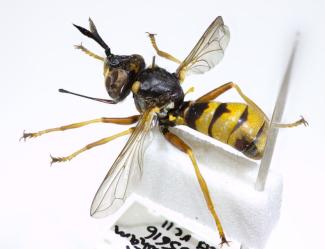
Conops quadrifasciatus belongs to the fly family Conopidae, known unflatteringly as the ‘thick-headed flies’ because their heads can be broader than the thorax (the next section of their body)! They actually behave like solitary wasps, and even the fly’s black-and-yellow colouration mimics wasps.
Another characteristic of these flies is the long proboscis used for sucking nectar and feeding on pollen; they may be seen in flower-rich habitats typically frequented by bees. With its long legs, the female Conops will grab a bumblebee in flight, taking it to the ground where its specially adapted ovipositor levers a segment of the bee’s abdomen apart and inserts an egg.
The fly egg hatches in the bee’s body, and the emerging larva attaches itself onto its respiratory system before starting to feed on the host. As the larva develops, the bee’s behaviour changes – it may restrict its foraging range for example, or not return to its nest – until, during the last stages of the fly larva’s development, it buries itself in the soil before it dies. The larva pupates in the shell of the bee and, protected from the weather, overwinters until, as an adult fly, it digs its way out of the soil.