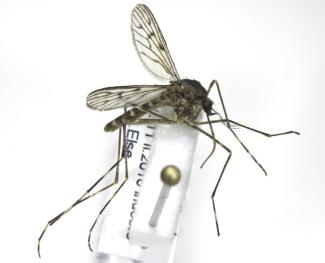
The Banded mosquito, Culiseta annulata, is the largest, and one of the commonest, mosquitoes present in the UK. It may be found breeding in a variety of both natural and artificial water sources ranging from brackish water found in marshes and ditches, to the cleaner water present in a garden water butt.
C. annulata is a cold tolerant species which remains active throughout the winter months without the need to enter a period of diapause (a state of suspended development); this means that the female can continue nuisance-biting, both indoors and out, late into one year and early into the next.
It is only the female which requires a blood meal for the proteins needed for egg-laying otherwise, like males, they feed on plant sugars from sap and nectar for energy. With her complex mouthparts, she can cut through and pierce the skin of the host, be it man or another vertebrate, and inject saliva prior to sucking up the blood. The introduction of the saliva aids the blood acquisition as it contains an anticoagulant (to prevent the blood clotting), a vasodilator (which expands blood vessels to increase the flow to the penetration site), and an anaesthetic (to prevent the host feeling the ‘bite’). Unfortunately, as well as proteins which suppress the immune system, research has indicated that it also contains a cocktail of infectious agents!
The female mosquito lays her eggs on the surface of the water and, on hatching, the emerging larvae hang down from the water surface sifting out the microorganisms and remains of organic matter on which they feed; air for breathing is obtained through a spiracle (a tube at the end of the body which penetrates the water surface). The comma-shaped pupae, the final phase in the development of a young mosquito, is a non-feeding stage that typically hangs from the water surface by a pair of respiratory trumpet-shaped structures. Depending on the water temperature, this final stage is completed in under a week, and a young adult mosquito emerges.