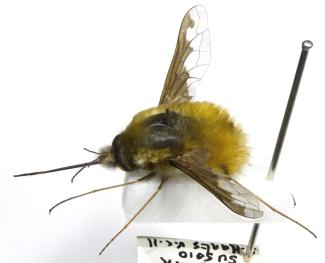
With its broad hairy body, it is not surprising that the common name for Bombylius major is the ‘Large bee fly’, and it may easily be mistaken in flight for a bumblebee.
This resemblance to bees allows Bombylius to fly close to the nest sites of solitary bees, where it may hover while flicking its eggs near the entrances to their underground nests. After hatching, a fly larva makes its way into a solitary bee’s nest where it feeds on young solitary bees and their food store. It eventually pupates and overwinters in the hosts nest before emerging in the spring as an adult fly.
The long rigid proboscis is used by the adult fly for sucking nectar from flowers; it can achieve this while still hovering in the air without actually entering and pollinating the flower – a process known as ‘nectar robbing’.