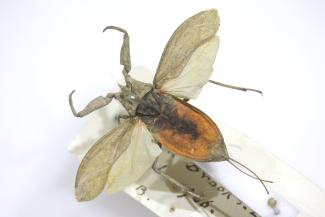
The water scorpion, Nepa cinerea, is, as it looks, a fierce freshwater predator. It is not surprising that its menacing appearance, however, has given rise to several misconceptions: it is not a true scorpion and is harmless to humans; it is not venomous, and its long, two-part tail is not a ‘stinger’ but a pair of half-tubes which, when locked together, forms a siphon that can conduct air from above the water surface to its respiratory system.
Its real danger is to other aquatic insects and small animals like fish and tadpoles that are living in its pond, lake or stream. The flat body of water scorpions enables them to remain hidden amongst the vegetation at the bottom of their habitat waiting to surprise their prey. The forelegs have been modified into strong, rigid pinchers (each with a sharp piercing claw) that fold over the body of the prey to grip it firmly - before internal fluids are sucked up using its sharp proboscis mouthpart.
The other two pairs of legs are used for crawling along the bottom of the pond or lake in which it lives. Although the water scorpion has two pairs of wings, the first pair are hardened to protect the second, membranous pair, which are used for flying to a more permanent watery habitat if, say, its pond has dried out.
Adult water scorpions hibernate during the winter in the mud and vegetation at the bottom of their habitat. Mating occurs in the spring, and the female lays clusters of eggs in the vegetation just below the surface of the water. Nymphs (looking like miniature, wingless adults) hatch in about a month and after about five moults and several months development, they reach maturity.
A south-east Asian relative, the Giant water bug, is ‘preyed’ upon by humans! Large numbers of these insects are required because the males produce a pleasant-smelling chemical which is extracted and used to flavour some luxury dishes. In other places, they are simply cooked and eaten as a snack!