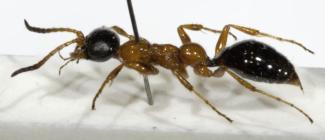
The male Methocha articulata may be found during the late spring and summer, flying around flowers and seeking a mate on the sandy heaths and coastal dunes in southern areas of the UK. However, the wingless female, which has an ant-like appearance, spends her time searching over the ground for the larval burrows of the tiger beetle (see Cicindela campestris on this ‘Collections’ website) - these beetle larvae are ‘ambush predators’ of ants and other small arthropods.
The beetle larva waits in the entrance of its burrow to grab passing prey and drag it back into the hole to consume. The Methocha female provokes the beetle larva into attacking, but positions herself so that as it rears up to grab her, she quickly stings the larva several times to immobilise it and then drags it back down to the bottom of the burrow. The wasp lays a single egg on the larva’s paralysed body before leaving the burrow and sealing it with sandy soil to prevent disturbance by other insects.
After the egg hatches, the emerging wasp larva feeds on its immobile host, and once it has been completely devoured the beetle larva, it creates a chamber in the burrow in which it enters the pupal stage of its development. It is in this stage that in undergoes the dramatic change into an adult wasp.