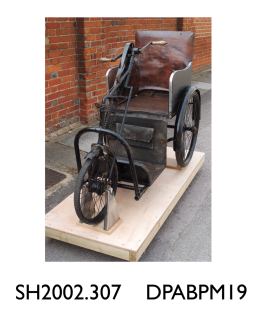
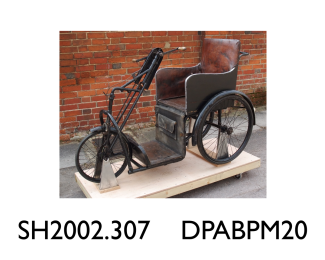
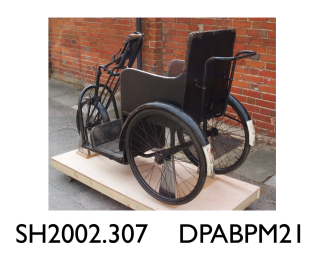
driven front steering wheel
This invalid carriage is called the bath chair, and it was invented by James Heath, of Bath under the R. A. Harding Company which was founded in 1921. It was one of the early inventions of three-wheeled wheelchairs, with hooks to be pulled by horses or servants. James Heath borrowed the idea from Stephan Farffler, a Nuremberg watchmaker whose invention of a manumotive carriage in 1655 is widely considered to have been the first self-propelled wheelchair. After this hand propelled invalid carriage, in 1926 Harding's introduced a variety of powered invalid carriages. The De Luxe Models A and B were powered by a 122cc Villiers engine, and the Pultney was powered by either a 200cc or 300cc JAP.
Initially, the invalid carriage was designed before World War One for disabled people for movement from one place to the other. However, after the First World War, the UK government began to provide the carriages to wounded servicemen free of charge to aid their movement as many of them became disabled due to their injuries. Although they were viable modes of transport to the ex-service men, the UK government, after assessing the everyday challenges that were posed by these invalid carriages to human life such as often rolling over on account of their unstable shape and catching fire due to fibreglass cladding, it then banned them, recalled and crashed them in 1976. While a lot of people listened to the call of the government of banning them, some hid them from the authorities in barns and backyards. Researcher and enthusiast Simon McKeown who owns the UK’s largest collection of invalid carriages at that time was one of the people who did not surrender all his invalid carriages. He kept this early invention for historical purposes, and he later donated it to the museum.
This object was audited and researched as part of the Heritage Fund Data Hunters and Story Gatherers project.