Design
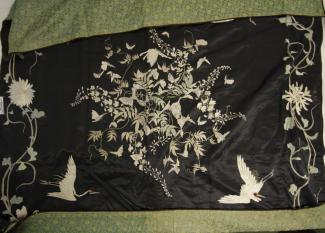
The hanging depicts four cranes on contrasted against a black background with flowers and butterflies embroidered in the centre. These elements combine to portray a message of life, longevity and joy through associated and symbolic meanings attached.
Butterflies
In Japanese culture, butterflies are perceived as spiritual creatures with their beauty contrasted with their short lifespan. Consequently, butterflies are considered as carriers or guides of souls towards the afterlife. Conversely, butterflies are also simply appreciated for their beauty and array of colours making them aesthetically pleasing symbols for clothing and textiles.
Cranes (Tsuru)
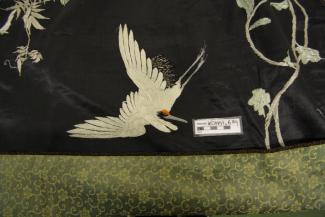
The hanging contains four red-crowned cranes, two of which are covered in the image by the fold. The red-crowned crane is an endangered species native to Hokkaido. The crane is a symbol of good luck, longevity and fidelity and is associated with two famous folktales being the Grateful Crane, Tsuru no Ongaeshi, and Sakado and the Thousand paper cranes. First, the Grateful crane follows a poor farmer who saves and heals an injured crane. To repay this kindness, the crane takes the form of a woman who declares herself as the farmer's wife and begins to create beautiful cloths from her own feathers. Next, Sakado's story is one of peace, hope, and recovery. After suffering from radiation, 12 year old Sakado began to craft 1000 cranes with the hope that she would be granted a wish and recover. Unfortunately, Sakado's wish would not come true yet, her story becoming a rallying call for the nation to move towards recovery.
This object was audited as part of the NHLF Data Hunters and Story Gatherers project.