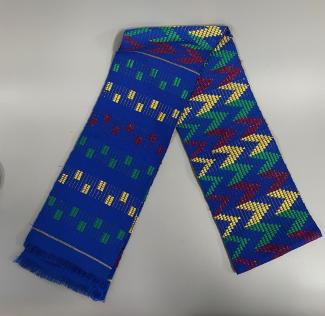
A Kente stole made from blue woven fabric, featuring a repeating chevron design in shiny red, gold, and green along the central band. On either side, there is a geometric key meander pattern in the same colours. The designs and the fringed ends are separated by narrow gold lines. The stole was originally brought to Basingstoke by the donor after relocating from Ghana. It would traditionally be worn draped over either the left or right shoulder.
The origins of Kente cloth trace back to 12th‑century Ghana, particularly among the Ashanti people, who remain the most prominent weavers of this iconic fabric. According to Asante mythology, its invention was inspired by Ananse the Spider, a cunning trickster who created an intricate web in the forest. Two brothers and weavers, Nana Koragu and Nana Ameyaw, were captivated by its beauty and, upon studying the design, sought to replicate the artistry through weaving. From this inspiration came Kente, which has since grown into one of Africa’s most celebrated textiles.
Kente cloth derives its name from kenten, meaning “basket” in the Asante language, a reflection of its woven appearance. Traditionally, it was a sacred fabric worn by royalty and reserved for special occasions such as weddings, festivals, naming ceremonies, and other significant milestones. It continues to hold social and spiritual importance, as every design and colour in Kente carries symbolic meaning. For example, gold represents status and serenity, yellow signifies fertility, green denotes renewal, blue embodies harmony, red communicates passion, and black represents a spiritual bond with ancestors. Maroon, drawn from the colour of the earth, is associated with healing.
The style in which Kente is worn differs by gender: men traditionally drape it over one shoulder in the fashion of a Roman toga, while women wear it as a two‑piece ensemble, with an ankle‑length garment and a shawl that may also serve as a baby sling. The fabric is therefore more than clothing; it is a visual language that conveys messages of identity, social rank, and values.
Historically, silk was the principal material in Kente weaving, making it expensive and exclusive. Today, however, it is also produced with cotton, rayon, and metallic threads, which add variety and accessibility. In modern usage, its scope has broadened beyond ceremonial attire to items such as handbags, dresses, and shoes. Outside Ghana, Kente has become a cultural symbol of unity and heritage. In the United Kingdom and the United States, it is frequently worn during church celebrations, graduation ceremonies, Kwanzaa, Juneteenth, and other occasions that honour African roots.