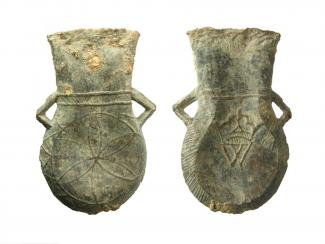
Lead or tin-lead pilgrim badge/ampulla with angular loops for suspension. On the front is engraved a compass-drawn six-petalled flower within a circle, with a zig-zag line around the body, and on the back is crowned W. Round the neck is a collar folled with slanting lines.This is a late form, dating to the late 14th or 15th century, and the crowned W suggests that this ampulla is from the shrine of Our Lady of Walsingham, but the attribution is not absolutely certain. From VR72-80, Victoria Road, Winchester, Hampshire. Excavated by Winchester Museums Archaeology Section, 1972-1980.
Pilgrim badge of lead or tin
Medieval, late 14th or 15th century
Found in the 1970s during excavations by Winchester Museums Archaeology Section at Victoria Road, Winchester, Hampshire
This badge is in the shape of an ampulla, or small flask, and would have held holy water. Decorated on one side with a floral design, it has two loops, so the wearer could suspend it around their neck, or from their clothing or hat to show where they had been on pilgrimage. As there is a 'W' and crown on the other side, the suggestion is that it was not bought at Hyde Abbey, but came from the shrine of Our Lady of Walsingham in Norfolk.