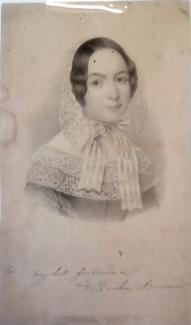
A print of an engraving depicting Fredrika Bremer in a lace bonnet tied with a large striped ribbon. The same lace is draped over the shoulders of her dress. Below her portrait is the inscription ‘Er my chit forbundn en Fridrika Bremer’. It was engraved by Dav & Haght, lithographers to the Queen, and printed by Longman & Co. in London, 1844.
Fredrika Bremer (17th August 1801 – 31st December 1865) was an author, activist, miniaturist, and reformer, who popularised the realist novel in Swedish literature. She was a key figure in women’s emancipation, and is argued to be the most influential women’s rights activist in Sweden. Bremer’s novels usually had romantic settings, describing a personal view of the marriage market, with women fighting to escape the constrictive environments they found themselves in. She also focused on domestic narratives, and familial relationships within the household, with a focus on the female figure. Her novels were an early example of work in which the readers could recognise their own lives. Because of this, Bremer became the author of the home and the family.
Her novel Hertha (1856) is regarded as the first feminist novel in Swedish literature, centring on Hertha Falk, a young, unmarried, middle-class Swedish woman with outspoken ideas about women’s lack of rights and opportunities. The debate provoked by Hertha brought forth a socialist movement that reformed Sweden's Civil Code of 1734, and in 1864 all Swedish women aged twenty five were granted legal majority. Previously, unmarried women (with the exception of widows and divorcees) were under the wardship of their male relatives. Bremer and her sister had personal experience with this, having to petition the Crown to emancipate themselves from their brother. They succeeded in December 1840 when Bremer was 39.
Due to Bremer’s established reputation as an author, Hertha was published simultaneously in English and Swedish, increasing the impact of its discussion beyond her home country. This international publication also led her work to be compared to Charlotte Brontë and Jane Austen. The Hertha debate inspired the establishment of Högre Lärarinneeseminariet (1861), Sweden’s first public institution of higher education for women. It also led to the creation of Sweden’s first women’s magazine, Home Review (1859), renamed Hertha in 1914. Bremer’s impact continues long after her death, through the work of the Fredrika Bremer Association (1884) that advocates for women’s and LGBT rights, and has been open to both women and men from its inception.
his object was audited and researched as part of the Heritage Fund Data Hunters and Story Gatherers project.