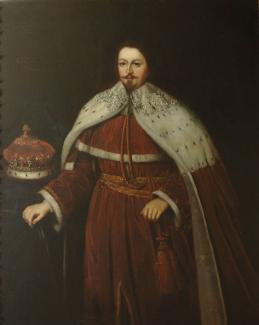
The Fifth Marquess of Winchester, Defender of Basing
Oil painting on canvas by an unknown artist, around 1670
A loyal royalist and devoted Catholic, Sir John Paulet lived through the English Civil War, a turbulent political era in British history. Known as the defender of Basing House, his fortified home, the Marquess held the last remaining royalist defence in Hampshire during the civil war.
The English Civil War started in 1642 after long standing disagreements between the King and Parliament culminated in the king invading Parliament with 300 soldiers to arrest five members. The war was not to truly finish until Charles II, who had been crowned in Scotland after the execution of Charles I, fled to France after the battle of Worcester in 1851.
Basing House was besieged on three occasions during the war, the third starting in August 1645. But Sir Paulet was not defeated until the arguably most famous Parliamentarian, Oliver Cromwell, joined the siege in October 1645. Basing House was then looted, burnt to the ground and its remaining stones removed.
Declared a traitor by Parliament, the Marquess was taken to the Tower of London. Unlike the king who was executed, Cromwell allowed Sir Paulet to flee to France. The Marquess later returned after the restoration of the monarchy in 1660 and lived in his wife's property Englefield House, Berkshire until his death in 1675 and is buried in the church there; the story of the siege of Basing House forms one of the most remarkable features of the Civil War.