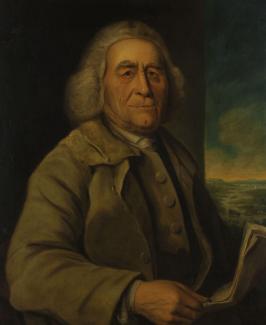
James Cooke
Oil painting on canvas by an unknown artist, around 1780
James Cooke was a local merchant who in the 18th century joined forces with William Meader and John Moody to break the monopoly that was held on the Itchen Navigation and make it available as a means of transporting goods for everyone.
The Itchen Navigation ran from Southampton to Winchester and was intended as a means of transporting goods such as coal. The Winchester wharf was at Blackbridge where College Walk, Wharf Hill and Domum Road meet. It is believed that the River Itchen was used to transport goods from the early 13th century but it was not until the reign of Charles II and a 1665 Act of Parliament that the Itchen Navigation, which we see the remains of today, came into existence. The navigation utilised the River Itchen as much as possible and re-engineered its course where necessary.
The navigation was never very successful, low bridges prohibited ships with tall masts from sailing up it and, as with other southern waterways, there was never a great deal of traffic wanting to use it. The last coal laden barge to use the navigation was in 1869.
James was obviously proud of this achievement as a representation of the canal can be seen on the right of the picture. When the picture came into the possession of the City in 1905 it was donated by a Mr Johnson but he had received it from Miss Moody, a descendant (4th generation) of John Moody.
James Cooke was a brewer and cole merchant, and the family resided in the Soke, Winchester for several generations working as clothworkers, tanners, and finally squires, from the reign of Queen Elizabeth. Several were buried in the old church of St Peter's Chesil.