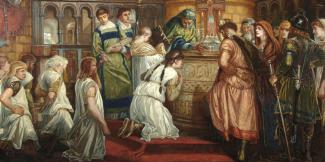
King Alfred and the Danes
Oil painting on canvas by Andrew Brown Donaldson, around 1890
The year 878 AD saw the Kingdom of Wessex on the verge of being totally overrun by Danish invaders and King Alfred and his army hiding on the Isle of Athelney in Someset. And yet by the end of the year Wessex was free of all Danish occupiers and the leader of the pagan Danish army had been baptised a Christian.
The Danish army had invaded Wessex before 878 AD and had attacked Wareham, Dorset in 875 but the Wessex army had managed to contain the Danes and by 876 had agreed terms with them. The Danes then attacked Exeter but their reinforcements were shipwrecked off the coast of Swanage in 877 and they withdrew to the neighbouring Anglo-Saxon Kingdom of Mercia. Alfred and the West Saxons probably thought they had until the following spring before they could expect fresh attack but the Danish King Guthrum took the unexpected step of attacking in January 878 and took the town of Chippenham in Wiltshire.
Caught by surprise and unprepared Alfred retreated to the marshland around the Isle of Athelney. However Alfred continued to engage the Danes and slowly built his army until they were able to take on the main Danish force near its base at Chippenham. Leading an army consisting of men from Somerset, Wiltshire and western Hampshire Alfred beat the Danish army led by King Guthrum at Edington, which is believed to have been to the south of Chippenham, in May 878. The battle was a decisive victory for Alfred and after a brief siege of Chippenham where the Danes had retreated to they agreed to leave Wessex for good and for Guthrum to be baptised a Christian.
Three weeks after the battle King Guthrum and 30 of his followers were entertained by Alfred over a period of twelve days and Guthrum was baptised with the Christian name of Athelstan. The Danish army remained at Chippenham for the duration of the summer but finally left in the autumn, moving to Cirencester in the kingdom of Mercia.
Alfred's victory over the Danes was very important to the Kingdom of Wessex, not just in the short-term but in the long-term also. The other Saxon Kingdoms were not so fortunate and by 879 Wessex alone remained independent of Danish interference. This paved the way for the Royal family of Wessex to be the creators of the Kingdom of England under Alfred's son King Edward the Elder and his son King Athelstan.
Andrew Brown Donaldson (1840 - 1919)
A painter of landscapes and religious and historical scenes Andrew Brown Donaldson was born in 1840, the second son of William Leverton Donaldson. He studied art at both the Royal Academy School and in Rome. Although working mainly in London, he undertook frequent painting trips to Europe. His works were exhibited at the Royal Academy, the Society of Painters, and also in numerous provincial exhibitions. In June 1872 Donaldson married Agnes Emily Twining, the youngest daughter of the tea merchant, Richard Twining.