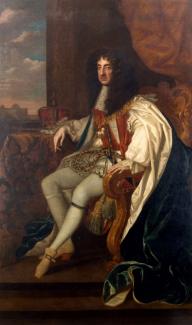
King Charles II
Oil painting on canvas by Sir Peter Lely, around 1680
King Charles II was the eldest son of King Charles I and was born in St James' Palace on the 30th June 1830. Charles grew up during the turbulent years of the English Civil War and at just 14 he participated in the military campaigns in the West County. However, as Parliament gained the upper hand in the war there were concerns for the safety of the young Charles and he fled England in 1646.
After the execution of his father in 1649 Charles should have been crowned King but Parliament made it unlawful for this to happen, Scotland however were prepared to crown Charles king of Scotland on their terms. Charles duly accepted the terms and was crowned King Charles II of Scotland on 1st January 1651. However, Charles was still in a very precarious position and decided to pre-empt an attack from England by launching his own attack. Forces led by Charles II entered England that same year but with little support they were defeated at the Battle of Worcester on 3rd September 1651. Charles managed to escape capture and it was while evading his pursuers that he hid in an oak tree. Charles again fled to Europe to await another opportunity to regain the throne of England. That opportunity came in 1660 after the collapse of the Protectorate and the reinstatement of a full Parliament. An invite was made to Charles to return to England as King Charles II and he was received in London on 29th May.
The painting by Lely was presented to the city by King Charles II in 1683 about the time he decided to build a new palace in Winchester; see link below. However, Charles died unexpectedly in 1685 and the place was left unfinished.
Peter Lely (1618 - 1680)
Peter Lely was born in Soest, Westphalia the son Johan van der Faes, a Dutch infantry captain. The pseudonym Lely appears to have originated from the carved decoration of a lily on a property the family owned called In de Lelye, in Noordinde, Holland. Lely started his career as an artist in Holland but moved to England in about 1643 possibly seeing an opportunity after the death of Van Dyck.
Lely soon started to pick up commissions from influential sitters and in 1647 was commissioned to paint a group portrait of the children of King Charles I and in 1648 a double portrait of the king with his second son, James, Duke of York. Lely continued to work through the Commonwealth and Protectorate periods and was commissioned to paint a portrait of Oliver Cromwell while also performing commissions for former courtiers and possibly maintaining links with exiled Royalists on the continent. 1660 saw the restoration of the monarchy and Lely was appointed principal painter to Charles II in the same year. Lily's most productive relationship however was with the king's brother, James, Duke of York, and his first wife, Anne Hyde daughter of the Earl of Clarendon.
Although much work was performed by Lely he ran a very busy studio and often only the head of a sitter would actually be painted by Lely. Studio painters would complete the rest often from chalk sketches made by Lely at the initial sitting. Many pictures produced were copies of original Lely paintings performed by studio artists using a tracing from the original.
Lely died in his Covent Garden studio on 30th November 1680 and despite his success he left large debts. He also left a large personal collection of painting which was sold to pay the debts and fulfil the condition of his will.