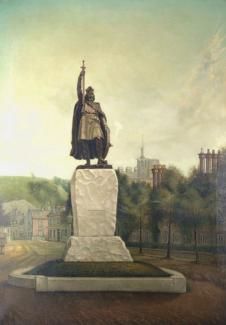
Statue of King Alfred in the Broadway
Oil painting on canvas by Henry Edward Locke, 1904
The statue of King Alfred was unveiled on the 20th September 1901 and so this is an early record of what is now an established landmark. The statue was meant to commemorate the 1000th anniversary of the death of King Alfred but, due to confusions over medieval dates, it was two years late as Alfred died in 899 AD.
The unveiling of the statue was part of the Alfred Millenary celebrations of 1901. Although the idea for a celebration of King Alfred's life was a national idea and a national steering committee had been set up Winchester was keen to be chosen as the hosting city. In this aim they were energetically championed by Alfred Bowker a city councillor and mayor of Winchester at the important planning stage of the Millenary in 1898 and at the time of the event itself in 1901.
The statue of King Alfred was paid for by public subscription and the commission was won by the sculpture Hamo Thorneycroft. Thorneycroft was paid £5000 four the statue but this was to cover all materials including the granite plinth. The statue was cast in Frome and the granite came from Cornwall and the shear size and weight of both caused delays and complications in the erection. Although originally planned for June the statue was formally unveiled on the 20th September 1901.
Henry Edward Locke (1862-1925)
Edward Locke was a Southampton topographical artist who was most prolific during the period 1888 to 1904. Southampton City Museum has eight Locke paintings in its collection.