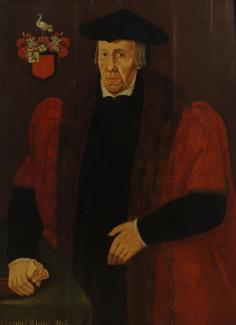
Sir Thomas White
Oil painting on panel by an unknown artist, around 1600
Sir Thomas White KT 1492-1567, was an Alderman of the City of London, Master of the Merchants Taylor Company and founder of St John's College in Oxford. He was born in Reading, Berkshire, the son of William White, a clothier, and brought up in London. The Sir Thomas White Loan Charity was founded in 1542 and is still extant. It gives interest-free loans to aspiring businesspeople in Leicestershire and Rutland. There are several memorials to White in England and he is honoured on Leicester's Clock Tower.
Thomas White was twice married, to Avicia (died 1558) and to Joan. A principal member of the Guild of Merchant Taylors, he served as Sheriff of London in 1547, and was elected Lord Mayor of London in 1553. He was knighted in the same year by Queen Mary I and was a member of the commission for the trial of Lady Jane Grey.
In 1555, inspired by the example of Thomas Pope, founder of Trinity College, Oxford, White obtained a royal licence for the foundation of St John's College, Oxford. The college was dedicated to the patron saint of the Merchant Taylors and established in the buildings of the dissolved Cistercian College of St Bernard. He was involved in the foundation of the Merchant Taylors' School, and made provision that scholars of the college should be nominated from pupils of the school. He also established scholarships (still awarded today) at St John's College, tenable by pupils of Bristol Grammar School, Reading School and King Henry VIII School, Coventry, where one of the school's four houses bears his name. He purchased Gloucester Hall and set it up in 1560 as a hall of residence for scholars; this became the basis of the later foundation of Worcester College. As a result of his philanthropy, he was listed in Richard Johnson's Nine Worthies of London in 1592.
In 1566 he gave £2000 to the Corporation of Bristol on condition that they should purchase an estate. Out of the rents they paid yearly the sum of £104 in regular succession to one of twenty four cities and towns named in the deed, one of which was Winchester. He also left to Winchester £25 each for four young men.