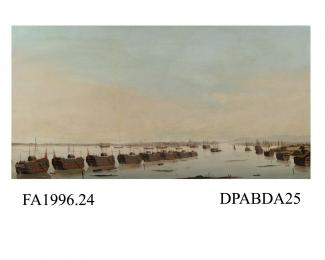
Painting, oil on canvas, set within a gilt gesso frame, Prison Hulks in Portsmouth Harbour, with two rows of prison hulks looking south towards Old Portsmouth and Gosport, Isle of Wight in background, by Ambrose Louis Garneray, c1806-1814
Ambroise Louis Garneray was born in 1783 in Paris. The son of Jean-Francois Garneray, a pupil of Jacques Louis David who later became a painter at the court of King Louis XVI, the young Ambroise undoubtedly drew inspiration from his father and his associates.
At the age of 13 and seeking a life of adventure, Garneray joined the French Navy and embarked for the Indian Ocean where he was stationed on the islands of Mauritius and Reunion. In 1799, he was part of the crew of the Preneuse as a helmsman and painter-on-board when the ship had to surrender to the British. The Preneuse was the last official French naval vessel in the area but Ambroise escaped capture by jumping ship and swimming to land on Mauritius.
In absence of French naval presence, Garneray joined Captain Robert Surcouf on the corsair Confiance as an ensign. He was part of the crew when they took the ‘Kent’ in 1800 and invested his share of the prize money in the slaving ship ‘Union’ on which he also served. During the short peace brought on by the Treaty of Amiens in 1802, Garneray served on various merchant ships before returning to active service with the French navy when hostilities with Britain renewed in 1803. He was made a prisoner by the British in 1806 while on board the Belle Poule.
He spent the years from 1806 to 1814 as a prisoner of war during which time he was interred on the prison hulks off Portsmouth. He spent his time painting in order to earn a little money, producing a number of views of the hulks moored in the harbour between Portsmouth and Gosport, which were sold through a British art dealer.
After his release in 1814, he was unable to find work with the French merchant navy and returned to Paris to paint. He received his first major commission in 1815 to paint the arrival of the L’Inconstant and the Zéphir bringing Napoleon back from Elba, although the work was not completed until 1834.
In 1817 Garneray was made the first Peintre de la Marine, or official painter of the French Royal Navy by the Duke of Angouleme. In 1833, he was made director of the Museum of Rouen and started working with the porcelain manufacture of Sevres. Although both his health and his career went into a decline in the 1840s he was awarded the Légion d’Honneur in 1852 and was received by Emperor Napoleon III. Garneray died in Paris in 1857.