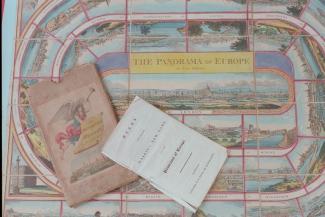
A Panorama of Europe is a Georgian board game first produced on 1st November 1815 by John Wallis and sons - Edward and John. Mounted onto 12 sections of linen and paper are 40 hand-coloured engravings of European cities. Players travel anticlockwise around the board, finishing in the centre at London. The rule case has a printed label of an angel.
Fancy a Grand Tour of Europe? Visiting cities including Amsterdam, Moscow, Lisbon, Florence and Rome was a rite of passage usually only available to wealthy men of Georgian society. This game enabled more people (male and female, young and old) to undertake this adventure without leaving the safety and comfort of their homes. No need to cross the English Channel in boats; no seasickness, or delays by bad weather; no need to travel across countries in horse-drawn coaches, stopping in numerous hotels and inns. By November 1815, Napoleon had been defeated at the Battle of Waterloo and continental travel was opening up again.
Would the modern player recognise the cities now? Gibraltar’s famous Rock, Edinburgh Castle, Rome’s Castle, Venice’s canals are all still clear landmarks. However, some names like Constantinople have changed (Istanbul) and Paris’ Eiffel Tower was yet to be built.