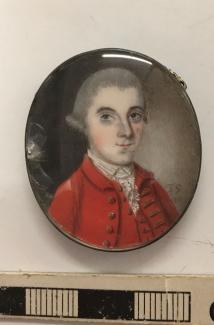
A portrait miniature of a young man. The unknown artist painted in the 1770s, and the style of the sitter is mostly characteristic of those found in the latter half of the eighteenth century. He is set against a black background in his daywear, donning a white shirt with a frilled cravat. Over this, he wears a red waistcoat and a matching overcoat with gilt buttons. He wears a classic grey Georgian wig, with tight rolled curls on either side of his head. The initials J.S and the number 70 are written on the right-hand side.
While the shirts in the Regency era (1795-1837) grazed the earlobes of the wearer, it was fashionable in the late eighteenth century to fold the shirt points down. The white coloured cravat symbolised a young man’s wealth due to its easily stained nature; simply the act of wearing it showed that he could afford to hire staff for its constant laundering. The plain cut and lack of pattern in his outerwear illustrate the growing preference for simpler, more modern styles in England. Taking inspiration from the Age of Enlightenment at the end of the eighteenth century, the Great Male Renunciation was a phenomenon where embellishment and colour were almost entirely drained from men’s fashion, preferring to focus on cut and cloth quality instead. Even the British Calvary, known for their iconic red coats, soon had the rifle regiment switching to green in 1802. The red ensemble in this miniature is an example of one of the few bright colours that remained in the palette of the fashionable Georgian man.
This object was audited and researched as part of the Heritage Fund Data Hunters and Story Gatherers project.