Design
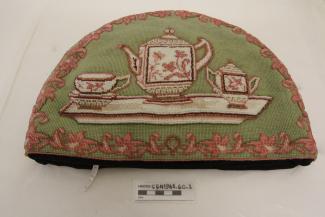
The tea cosy contains white, pink, and gold coloured beads to create an image of a tea service. The green background is a light green and cross stitched with a border of pink flowers and foliage. Lastly, the tea cosy is padded and lined with a black cotton sateen to provide the insulation required.
History and functionality
As tea drinking became a social affair and increasingly popular during the Victorian era (1837-1901), there was a need to keep tea warm for extended periods of time and therefore, the tea cosy became a commonplace object to achieve this purpose. With this additional layer of insulation, a tea cosy could keep a pot of tea warm for at least one to three hours, removing the need for a constant supply of hot water. Consequently, this meant that it was possible to prepare tea prior to a guest's arrival allowing for the practice of tea drinking to be a leisurely, relaxing, and simple experience.
Interestingly, for the wealthy tea consumers, tea in general became a way to reflect social status also shown in similar products like porcelain tea cups, saucers, and tea cups. Here, the social act of tea drinking became an opportunity to flaunt intricate designs, expensive porcelain, and show the individual's wealth. An example of this is the beetle wing tea cosy (HMCMS:C2008.245).
This object was audited as part of the NLHF Data Hunters and Story Gatherers project.