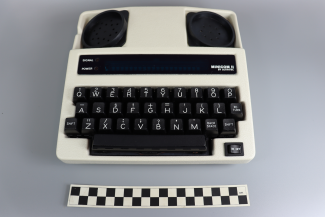
This minicom represents a pivotal moment in the history of accessible communication. A minicom is a type of TTY (Text Telephone) device, which allowed deaf and hard-of-hearing individuals to communicate over telephone lines using typed messages.
The roots of this technology trace back to the teleprinter, itself a natural evolution from the telegraph and Morse code. In the late 1960s, Robert Weitbrecht, a deaf scientist in the United States, developed the first acoustic coupler modem for TTY communication. He was inspired and encouraged by Dr. James Marsters, a deaf orthodontist who saw the potential for transforming how deaf people connect.
In the UK, the breakthrough came in 1973, when Andrew Kenyon in London and David Hyslop in Birmingham, both deaf directors of the Breakthrough Trust, made the first TTY phone call. They used reconditioned Post Office teleprinters and a Phonetype modem system based on Weitbrecht’s invention. This pioneering setup was facilitated by Michael King-Beer of Finedon Communications, a Breakthrough Trust initiative.
The process was simple yet revolutionary: one person typed a message, and it was printed out at the other end in real time. This two-way text communication laid the groundwork for modern digital messaging.
By the late 1970s, teleprinters began to be replaced by computers with dial-up modems, allowing messages to be sent and received over standard phone lines. This shift eliminated the need for specialized networks and opened the door to early online messaging systems, which eventually evolved into chat rooms and social networks.
This object was audited and researched as part of the Heritage Fund Data Hunters and Story Gatherers project.