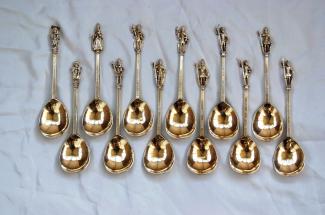
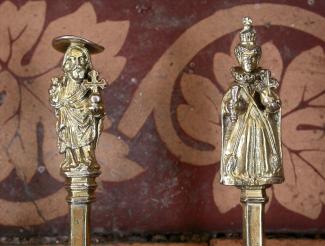
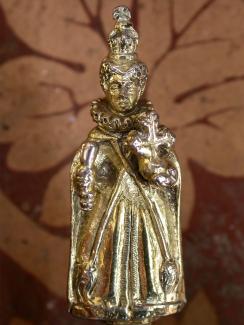
A set of twelve spoons: silver-gilt, bearing the maker’s mark of William Cawdell and London hallmarks for the year 1592.

William Cawdell was a specialist spoonmaker, supplying spoons wholesale and to commission. The archives of the Goldsmiths Company document an eventful career from his apprenticeship in 1575 to his death in 1625. Notably, in 1599 the Assay Office found that some of his work was of substandard silver. However, despite a succession of such offences, Cawdell had become a Warden of the Goldsmiths’ Company by 1621, and his will shows that he died in possession of considerable property.
Like ‘apostle’ spoons, on which the finials represent the twelve apostles with sometimes a thirteenth representing Christ, the Tichborne spoons are topped by human figures. However, this set is unique. Christ and St Peter have precedence, but next comes Queen Elizabeth I, who in turn is followed by a traditional grouping of heroes known as the Nine Worthies.
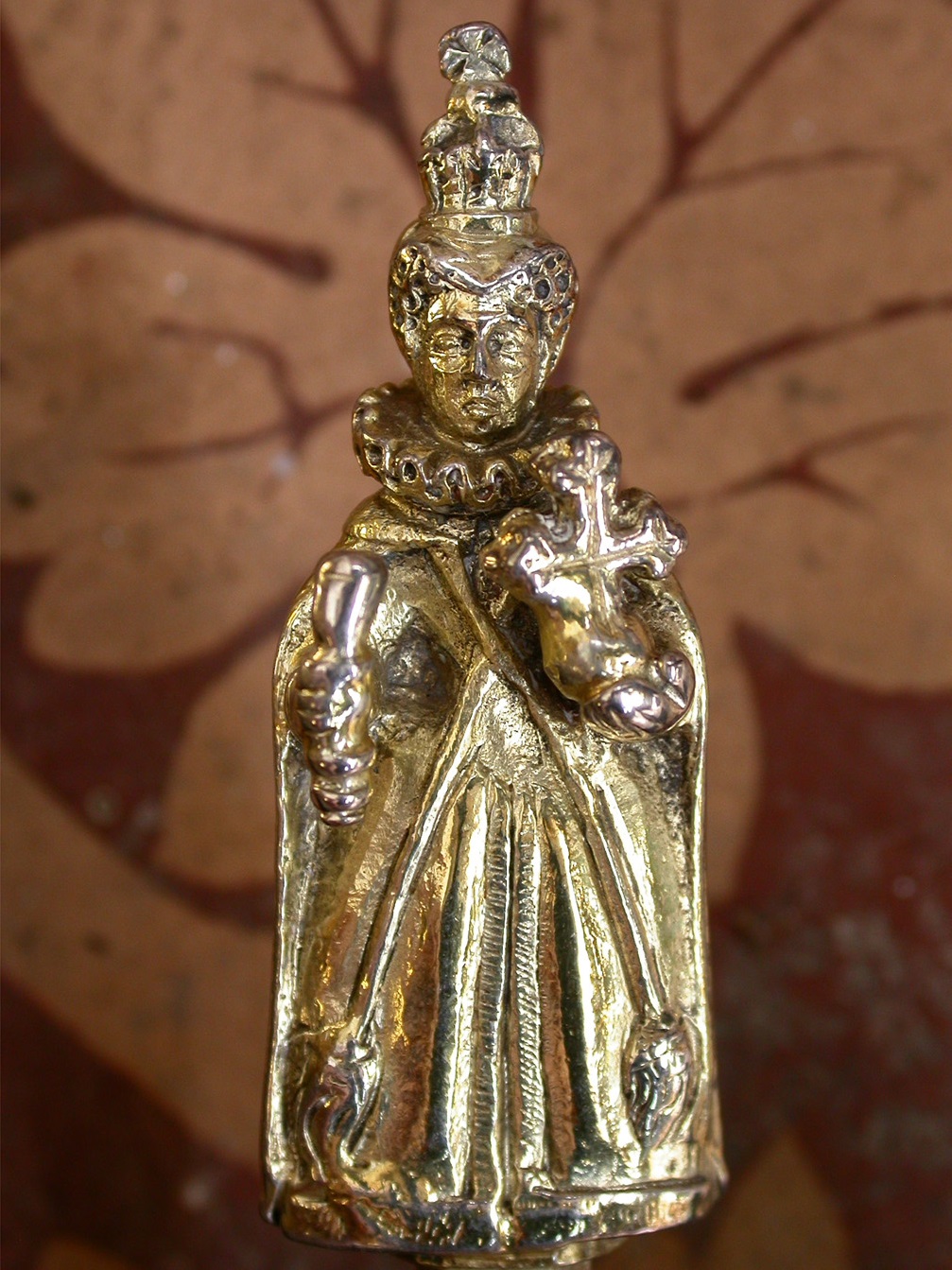
First referred to in a French poem of around 1312 and appearing in various media until the 17th century, the Worthies consist of three Christians, three Jews and three pagans. They are a mix of real and legendary figures. Of the Christians, Guy of Warwick , King Arthur and the Emperor Charlemagne, only the last was an historic character. King David, Joshua and Judas Maccabeus, the Jews, are respectively two scriptural figures and one who is generally acknowledged to have lived. The pagans, Alexander the Great, Julius Caesar and Hector of Troy, number two from the history books and one from epic verse.
Two of this group may be unfamiliar to us today. Guy of Warwick was a legendary warrior who is said to have saved 10th century Winchester from the Danes by defeating their champion in single combat. The other, Judas Maccabeus, was a Hebrew leader celebrated for having retaken Jerusalem from the Syrians in 165 BC.
Some other appearances of the Nine Worthies are worth noting. They feature in a play-within-a-play during the last Act of ‘Love’s Labour’s Lost’ (c1595), though Shakespeare fields a slightly different team, including Pompey the Great and Hercules. Sculptures representing them can be seen on the façade of Montacute House in Somerset (1600), and nine female Worthies appear on painted panels from Amberley Castle (C.1526) displayed at the Pallant House Gallery in Chichester.
The makers mark on these spoons was previously attributed to the silversmith Christopher Wase. There is no evidence that Wase made spoons. Furthermore, items baring the same makers mark have been identified dating from 1609, three yerar's after Christopher Waces death.