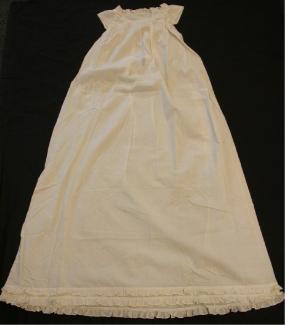
This well-preserved white day dress, assumed to be a toddler or children’s due to its size, was produced between 1810 and 1819 as indicated by the construction of the bodice and the ‘kite’ effect typical of this period. The hem is decorated with two horizontal frills, each set on a tuck, framing the flat skirt and pintuck bodice. The short sleeves are edged in the same fashion, joined to the bodice via a strap continuation from the front bodice. This piece is a brilliant exhibition of 19th century handsewn dresses worn throughout this period.
Donated by the Chute family, the long-term inhabitants of the Vyne estate in Hampshire, this piece is one of many demonstrating the style. The Vyne originated as a series of medieval buildings before being transformed into a Tudor palace in the early 16th century, following the promotion of William Sandys to Lord Chamberlain within King Henry VIII’s inner circle. A century later, the estate was inherited by the Chute family, who held the property within the family before it was generously passed to the National Trust in 1956.
This object was audited and researched as part of the National Lottery Heritage Funded Data Hunters and Story Gatherers project.