You searched for: Druitt
Results: 179
Filter search results
-
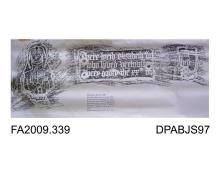
Fine artBrass rubbing / RubbingHMCMS:FA2009.339Brass rubbing, in black heel-ball, on white paper, Elizabeth Gaunt, wife of Robert Gaunt, half effigy, died in childbirth 1580, with mutilated inscription, St Nicholas Church, Ringwould, Kent, by Herbert Druitt 24 June 1899Visit Page
-
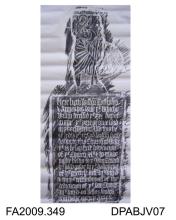
Fine artBrass rubbing / RubbingHMCMS:FA2009.349Brass rubbing, in black heel-ball, on white paper, figure of St Christopher and 16 line inscription to William Complyn, 1498, and his wife, Agnes, church at Weeke (or Wyke), near Winchester, Hampshire, by Herbert Druitt, 4 August 1899Visit Page
-
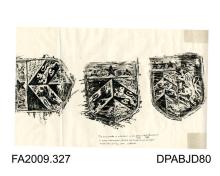
Fine artBrass rubbing / RubbingHMCMS:FA2009.327Brass rubbing, in black heel-ball, on white paper, 2 shields on altar tomb of Sir Robert Parkhurst, 1636, and his lady, 1638, Holy Trinity Church, Guildford, Surrey, by Herbert Druitt, 21 July 1905Visit Page
-
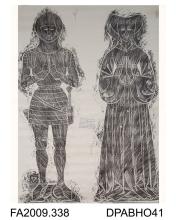
Fine artBrass rubbing / RubbingHMCMS:FA2009.338Brass rubbing, in black heel-ball, on white paper, Thomas Brokhill, 1437, in armour, with wife, Joan Fineux, marginal inscription and shields lost or mutilated, church of SS Peter & Paul, Saltwood, Kent, by Herbert Druitt 30 June 1899Visit Page
-
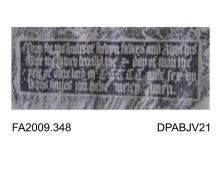
Fine artBrass rubbing / RubbingHMCMS:FA2009.348Brass rubbing, in black heel-ball, on white paper, inscription plaque relating to Steven Falkes, 1506, and his wife, Alys, 4 lines of Latin text, church of St Martin, Canterbury, Kent, by Herbert Druitt, 28 June 1899Visit Page
-
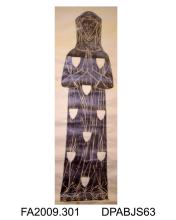
Fine artBrass rubbing / RubbingHMCMS:FA2009.301Brass rubbing, in black heel-ball, cut out and laid on to white paper, Margaret de Camoys, c1310, in kirtle, cote-hardie, wimple and veil, 9 shields on dress, church at Trotton, Sussex, by Herbert Druitt, 1876-1943Visit Page
' The earliest brass of a lady which survives in England is that of Margaret de Camoys, c1310, at Trotton, Sussex. She wears a long and flowing COTE-HARDIE, the sleeves of which end a little below the elbows, thereby exposing the tight fitting buttoned sleeves of the KIRTLE, which end at the wrists. Round the throat is a WIMPLE, covering the chin and carried up the sides of the face, to which it gave a triangular appearance. On the head is the COVRECHEF, kerchief, or veil, falling upon the shoulders, and held in place by two pins on either side of the forehead, which, probably, also help to sustain the wimple. The hair is bound by a narrow fillet across the forehead, allowing a small curl to appear on either side. Pointed shoes cover the feet, at which lies a small dog. The hands are clasped in prayer. Originally the cote-hardie wa semee of nine enamelled shields, which have been stolen. The slab was also sprinkled with flowers (marguerites?) and held eight shields. The effigy was enclosed by an elegant crocketed canopy (lost) with slender side shafts. Round the verge of the slab the Lombardic-uncial inscription ran - MARGARETE : DE : CAMOYS : GIST : ICI : DEUS : DE : SA : ALME : EIT : MERCI : AMEN' (Source: A Manual of Costume as Illustrated by Monumental Brasses, Herbert Druitt, pub1906)