

You searched for: All
Results: 17469
Filter search results
-
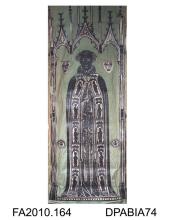
Fine artBrass rubbing / RubbingHMCMS:FA2010.164Brass rubbing, in black heel-ball on white paper, cut out and laid on to fabric, John Sleford, 1401, rector, master of the wardrobe to Edward III, canon of Ripon and Wells, rebuilder of the church and erector of the stalls in cope with SS, triple canopy with Trinity, soul, seraphim, arms of England and of Queen Phillipa, church at Balsham, Cambridgeshire, by Herbert DruittVisit Page
-
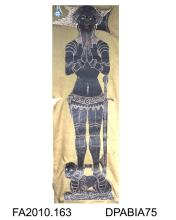
Fine artBrass rubbing / RubbingHMCMS:FA2010.163Brass rubbing, in black heel-ball on white paper, cut out and laid on to fabric, Sir William Tendring, 1408, in armour, bare-headed with beard, church at Stoke-by-Nayland, Suffolk, by Herbert DruittVisit Page
-
Fine artBrass rubbing / RubbingHMCMS:FA2010.162Brass rubbing, in black heel-ball on white paper, cut out and laid on to fabric, Joyce Tiptoft, 1446, daughter of Sir Edward Charlton, Lord Powis, wife of Sir John Tiptoft, in heraldic mantle and coronet, fine triple canopy with 6 shields on side shafts, church at Enfield, Middlesex, by Herbert DruittVisit Page
' Wearing kirtle, ermined sideless cote, heraldic mantle charged with Charlton impaling Holland, and a large necklace. The veil is curiously treated'. ( Source: A Manual of Costume as Illustrated by Monumental Brasses, Herbert Druitt, pub.1906)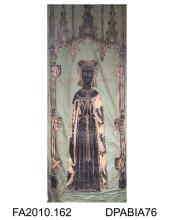
-
Fine artBrass rubbing / RubbingHMCMS:FA2010.161Brass rubbing, in black heel-ball on white paper, cut out and laid on to fabric, Sir William Fitzralph, c1323, in armour, cross-legged, with shield, canopy lost, church at Pebmarsh, Essex, by Herbert DruittVisit Page
' Bearing this same date, AD 1320, the 8th of Edward II, and preserved in the church of Pebmarsh, near Halstead in Essex, is the fifth and last remaining brass of this series: it commemorates a knight of the Fitzralph family; and, with a few trifling exceptions, it is in fine preservation. The arming and general equipment of this knight is precisely the same as I have already noticed in the Gorleston brass; with the exception of the ailettes, which are here omitted, and the mail which is interlaced chain-mail instead of the ring-mail. In this example also the arming of the legs and feet is completly expressed: it exhibits the jambarts continued from the ankles by lames, or small plates of steel, over the front of the feet, and thus forming the mixed sollerets of mail and plate. The surcoat is long and ample: the convex shield is apparanetly fringed, and its guige is broad and fastened over the hood by a buckle: the mail throughoput is admirably expressed: beneath the skirts of the hauberk appears the hauqueton, or quilted under garment, designed to protect the body from the pressure ofm its covering of reticulated steel: and bemneath the hauqueton are seen the gamboised cuisseaux. The genouilleres, with the several appointments of the sword, are elaborately enriched, and from the centre of the palettes small spikes project. At the feet of the knight reposes a dog' (Source: Monumental Brasses and Slabs, Rev. Charles Boutell, pub.1847)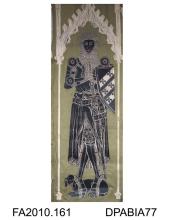
-
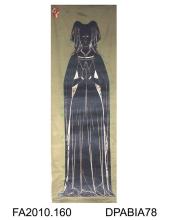
Fine artBrass rubbing / RubbingHMCMS:FA2010.160Brass rubbing, in black heel-ball on white paper, cut out and laid on to fabric, Joan Etchingham, 1404, in mantle, originally under triple canopy with husband, Sir William and son, Sir Thomas, dog at feet, church at Etchingham, Sussex,. by Herbert DruittVisit Page
-
Fine artBrass rubbing / RubbingHMCMS:FA2010.159Brass rubbing, in black heel-ball on white paper, cut out and laid on to fabric, unidentified cleric in ecclesiastical costume with dog at feet, location unknown,. by Herbert DruittVisit Page
