You searched for: All
Results: 17469
Filter search results
-
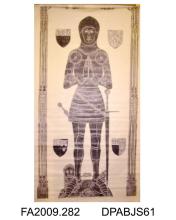
Fine artBrass rubbing / RubbingHMCMS:FA2009.282Brass rubbing, in black heel-ball, on white paper, Sir John Lysle, Lord of Wodington in the Isle of Wight, husband of Lady Elizabeth Lysle, died 1407, brass engraved c1425, in armour, triple canopy, marginal inscription and 4 shields, church at Thruxton, Hampshire, by Herbert Druitt, 1876-1943Visit Page
-
Fine artBrass rubbing / RubbingHMCMS:FA2009.281Brass rubbing, in black heel-ball, on white paper, Sir Hugh Hastings, 1347, builder of the church at Elsing, Norfolk, in armour with arms on jupon, shield on arm, head on cushion, legs lost, single canopy (mutilated), St George on pediment and 8 weepers (2 lost), by Herbert Druitt, 1876-1943Visit Page
' Eight weepers (2 lost) appear in the side shafts: Edward III, Thomas Beauchamp, Earl of Warwick, Despencer (lost), Roger, Lord Grey of Ruthyn (eff. replaced in 1905), Henry Plantagenet, Earl of Lancaster, Laurence Hastings, Earl of Pembroke (lost), Ralph, Lord Stafford, and Almaric, Lord St Amand, all in armour with armorial bearings on their jupons' (Source: A List of Monumental Brasses in the British Isles, Mill Stephenson, pub.1926)
' the brass of Sir Hugh Hastings is the most important of the three; for, in addition to the central figure, the sides of the canopy contained eight historic personages 9of which two are lost), all wearing this kind of jupon. Sir Hugh Hastings wears a rounded bascinet with a moveable visor, a steel collar or gorget ovber the camail, genouielleres with spikes and rowell spurs. The cuffs of the hawberg hang down, showing the hauketon below. Above the knees appear purpointed cuisseaux. The hands are bare. There are no jambs. The heater-shaped shield and the jupon each bear the Hastings arms:- Or, a maunche gules, with a label of three p;oints azure. The maunche is richly embroidered. (Source: A Manual of Costume as Illustrated by Monumental Brasses, Herbert Druitt, pub.1906)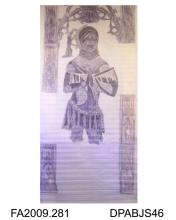
-
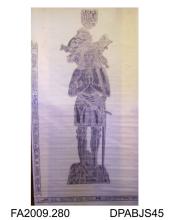
Fine artBrass rubbing / RubbingHMCMS:FA2009.280Brass rubbing, in black heel-ball, on white paper, William, Viscount Beaumont and Lord Badolf, 1507, in armour with head on helm and feet on an elephant, triple canopy and super canopy, marginal inscription and 1 shield, the side shafts and an Annunciation lost, church at Wivenhoe, Essex, by Herbert Druitt, 1876-1943Visit Page
-
Fine artBrass rubbing / RubbingHMCMS:FA2009.279Brass rubbing, in black heel-ball, on white paper, John Shelley, 1526, in armour with tabard, and wife, Elizabeth (Michilgrove) in heraldic mantle, Trinity, 4 shields, 4 lines of Latin inscription, church at Clapham, Sussex, by Herbert Druitt, 1876-1943Visit Page
' At the neck is worn a partlet, seen by the opening of the gown, and is usually of fine linen pleated and gathered round the neck. The pedimental head-dress, though its older variety is frequently found worn with the above dress, now assumes the form with which we are familiar in Holbein's portraits of the Queens and Court Ladies of Henry VIII' (Source: A Manual of Costume as Illustrated by Monumental Brasses, Herbert Druitt, pub.1906)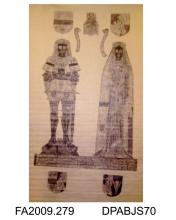
-
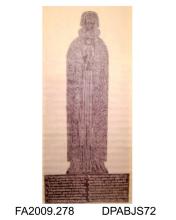
Fine artBrass rubbing / RubbingHMCMS:FA2009.278Brass rubbing, in black heel-ball, on white paper, John White, c1548, warden of Winchester College, latterly Bishop of Lincoln, in rich cope, marginal inscription, 20 lines of inscription at the base, deprived in 1559 and buried at Winchester Cathedral, Winchester, Hampshire, by Herbert Druitt, 1876-1943Visit Page
-
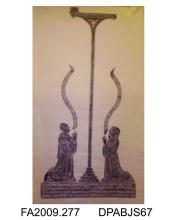
Fine artBrass rubbing / RubbingHMCMS:FA2009.277Brass rubbing, in black heel-ball, on white paper, John Spycer, 1437, and wife, Alys, in civilian dress, both kneeling to a bracket with scrolls, BVM and child under a small canopy (now lost), marginal inscription (mutilated), 4 lines inscription at feet, church at Burford, Oxfordshire, by Herbert Druitt, 1876-1943Visit Page