You searched for: All
Results: 17469
Filter search results
-
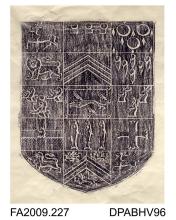
Fine artBrass rubbing / RubbingHMCMS:FA2009.227Brass rubbing, in black heel-ball, on white paper, unidentified coat of arms, shield divided into 15 different symbols, at Salisbury Cathedral, Wiltshire, undated, by Herbert Druitt, 1876-1943Visit Page
-
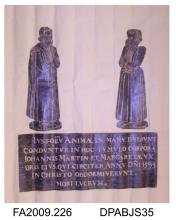
Fine artBrass rubbing / RubbingHMCMS:FA2009.226Brass rubbing, in black heel-ball, on white paper, John Martin in civilian dress and wife, Margaret, c1600, with six lines of Latin inscription, church at Barton, Cambridgeshire, by Herbert Druitt, 1876-1943Visit Page
-
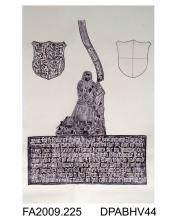
Fine artBrass rubbing / RubbingHMCMS:FA2009.225Brass rubbing, in black heel-ball, cut out and set down on to white paper, William Brocas of Beaurepair in armour, 1540, kneeling at prayer desk, with prayer scroll, two shields, 9 lines of Latin inscription, at St Andrew's Church, Sherborne St John, Hampshire, by Herbert Druitt, 1876-1943Visit Page
-
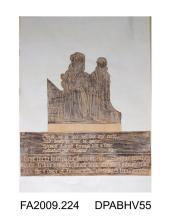
Fine artBrass rubbing / RubbingHMCMS:FA2009.224Brass rubbing, in black heel-ball, on buff paper cut out and set down on to white paper, Alice Swayn, 1599, aged 98 and son Arthur in civilian dress, both kneeling, with seven lines of English inscription, at Monxton Church, Hampshire, by Herbert Druitt, 1876-1943Visit Page
-
Fine artBrass rubbing / RubbingHMCMS:FA2009.223Brass rubbing, in black heel-ball, on white paper, Nicholas Kniveton in armour with SS collar and wife, Joan Mauleverer, c1475, with detached effigies of five sons (1 lost) and one daughter, 4 shields, at All Saints' Church, Mugginton, Derbyshire, by Herbert Druitt, 1876-1943Visit Page
' On this altar tomb both are shown standing full-face, she on a plot of grass, he with his feet resting on a flop-eared, bellied dog, and his head on a helm which depicts his crest - a fox looking at a reflection of itself in a mirrorunique heraldic device probably recalls the fable of a tiger (here a fox) that pursued hunters who carried off its cub. By throwing down the mirror, the hunters delayed the tiger that saw itself and imagined it was gazing at the lost cub. The crest may be suggestive of the knight's cunning in battle' (Source: www.hamline.edu/brass/pdf)
'...His armour seems more decorative than usual. The couters on the elbow, for example, seem to offer no opportunity to bend the arms, and the rerebraces on the uppewr arms have lines that seem insignificant...Pauldrons on the shoulders are symmetrical with a small haute-piece on each side to better protect the neck against blows of a sword...The SS livery collar is a Lancastrian insignia...Below the breastplate, Nicholas wears a short fauld of overlapping lames to which several scalloped tasses are attached...A misericorde or dagger appears at the right hip and a long sword with a large hilt and pommel hangs diagonally suspended by a belt in front of the body' (Source: as above)
'Below the two major effigies are four individual figures of four sons plus one more missing and one daughter. The sons, all practically identical, are in armour much like that of their father, and the one daughter wears a pedimental headdress and a dress with a full skirt, close fitting sleeves and fur cuffs and a low neckline. The brass of the fifth son...was once seen in the Bateman Collection of Antiquities at Lomberdale House in 1870, but no further trace has been discovered' (Source: as above)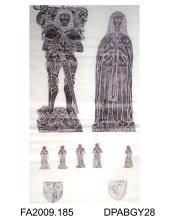
-
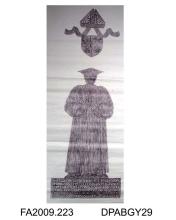
Fine artBrass rubbing / RubbingHMCMS:FA2009.222Brass rubbing, in black heel-ball, on white paper, George Ridding, Bishop of Southwell, 1904, in ecclesiastical attire, with bishop's mitre, shield, 6 lines of Latin inscription, at the chapel of Winchester College, Winchester, Hampshire, by Herbert Druitt, 1876-1943Visit Page
'This modern brass to George Ridding, first Bishop of Southwell, represents him full face, hands conjoined in prayer, standing on a grass plot with flowers. Clean-shaven, he wears long sideburns fashionable in the late nineteenth and early twentieth century. On his head is the modern mortar board. His foot-length robe has generous, slightly puffed sleeves that come to narrow cuffs, and over this he wears a very long scarf that reaches almost to the hem of the gown. Beneath, too, is a second long garment, perhaps a cassock. At the wrists are ruffled sleeves, perhaps from this undergarment. Above the effigy is what might be termed an ecclesiastical achievement though here the bishop'd mitre with infulae takes the place of helm with mantling. The shield displays on the left three roundels with wavy horizontal lines and a chief (top horizontal band) quartered in three with a seated buck, a Virgin and Child, and a raguly cross. These artms impale a chevron between three boars' heads' (Source: www.hamline.edu/brass/pdfs)
On a rectangular plate below the effigy are inscribed six lines of Latin capitals, the translation of which is: Sacred to the memory of George Ridding, S.T.P.( Professor of Sacred Theology), first Bishop of Southwell, who was born within the walls of this college, scholar, headmaster, instructor, fellow. Fell asleep in Christ the 30th day of the month of August A.S.1904, at the age of 77.