You searched for: All
Results: 17469
Filter search results
-
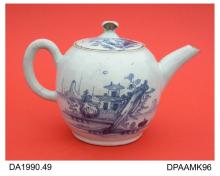
CeramicsTeapotHMCMS:DA1990.49Teapot, stoneware, globular shape, tin-glazed, decorated in blue on both sides with a house in a chinoiserie landscape, not marked, possibly made in Liverpool, c1775Visit Page
-
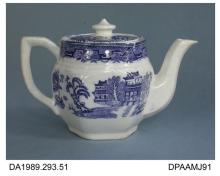
CeramicsTeapotHMCMS:DA1989.293.51Teapot, white earthenware, hexagonal with angular handle and button knop on ill-fitting lid, blue transfer printed Real Staffordshire Willow design, printed factory mark and pattern name on base, made by Harvey Adams and Co, Longton, Stoke-on-Trent, Staffordshire, c1870-1885Visit Page
-
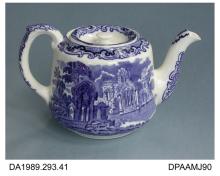
CeramicsTeapotHMCMS:DA1989.293.41Teapot, white earthenware, wide conical shape, blue transfer printed Abbey 1790 design, printed factory mark and pattern name on base, made by George Jones, Crescent Pottery, Stoke-on-Trent, Staffordshire, c1920-1950Visit Page
-
CeramicsTeapotHMCMS:DA1989.292Teapot, red stoneware, curved hexagonal shape with exotic birds and trees relief-moulded in panels, lid with Chinese lion knop, not marked, made by John and David Elers, Bradwell Hall, near Newcastle-under-Lyme, Staffordshire, c1690-98Visit Page
Around 1690 John Elers made a fine red unglazed stoneware, in the Chinese manner, at Bradwell Wood in Staffordshire. Production ceased around 1700, and red stonewares would not be produced again, in Staffordshire, until about 1750. The Elers brothers used a knowledge of casting in metal in order to form wares from liquid clay in moulds; the shape and decoration are both derived from contemporary teapots imported from China, though with added flourishes such as the long encircling extension to the lion's tail.
This is one of the earliest types of English teapot, small, expensive and intended for a wealthy consumer of the newly fashionable tea. In the absence of Chinese porcelain prototypes, this was inspired by red stoneware pots imported from Yixing.
Materials & Making
Red stoneware, favoured by the Chinese for making teapots that could safely be heated over a brazier, were imported into Europe shortly after the mid-17th century. Dutch potters immediately made copies, followed by the experiments of John Dwight at Fulham and his patent of 1684, and the arrival in London from Holland shortly after of the Elers brothers. They worked as Dwight's assistants in 1690-1693, then moved to Staffordshire, where they identified veins of suitable red clay at Bradwell Wood. The material was expensive, and there was no glaze to hide any blemishes formed in the course of manuftacture. The extremely high standard of craftsmanship displayed in the Elers's pots, as well as their subsequent bankruptcy in 1700, are attributable to their exclusive use of the silversmithing techniques they had learned years before in Holland: slip-casting and lathe-turning.
People
John Phillip Elers and David Elers, though claimed now as pioneer potters in Britain, always remained aloof from other potters, obsessively hiding their processes from possible rivals. Thus when red stoneware teawares were again manufactured in Staffordshire from around 1750, it was an independent rediscovery by local potters.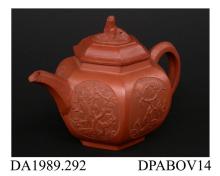
-
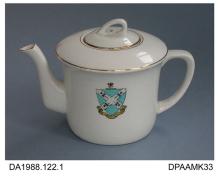
CeramicsTeapotHMCMS:DA1988.122.1Teapot, white earthenware, from a tea service for two in the collection, drum shape, printed and enamelled with the crest of Botley, Hampshire, not marked, probably made in Staffordshire, c1920-1935Visit Page
-
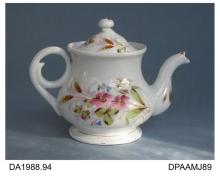
CeramicsTeapotHMCMS:DA1988.94Teapot, hard paste porcelain, pear shape with coiled handle, decorated with painted pink flowers, barley and bright gilding, not marked, possibly made in one of the European countries formerly constituting Bohemia, c1900-1910Visit Page