You searched for: All
Results: 17469
Filter search results
-
CeramicsStand / Dish / PearlwareHMCMS:HCMS1970.8Stand, white earthenware, decorated with printed grey 'Catskill Moss' border and 'Kosciousco's Tomb' at centre; base, printed pattern name and registered design mark with encoded date of 16th December 1844, made by William Ridgway, Son and Co, Hanley, Stoke-on-Trent, Staffordshire, 1844+Visit Page
Count Tadeusz Kosciousko (1746-1817) was a Polish patriot and a figure in the American War of Independence, during which he was responsible for improving the defences of many of General Washington's military strongpoints; the scene here is of his 'tomb' in the now rarely used sense of a monument to an individual not necessarily marking their gravesite; the structure was erected by students of West Point Military Academy, Virginia in 1828, fifty years after Kosciousco established the fort which later became the Academy; his actual place of burial was in Wawel Castle, Krakow, Poland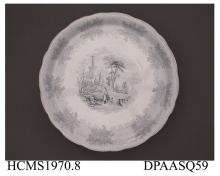
-
CeramicsShaving mug / JugHMCMS:DA2006.38Shaving mug, white earthenware, conical, with 7-shape handle and pewter-mounted Parian porcelain lid in the form of a man draped in a barber's sheet pensively fingering his beard, barrel of mug printed with two spiralling rows of bearded and beardless portrait heads and an accompanying proverb; base, printed FS monogram, designer's name and registered design mark with encoded date of 23rd November 1847, made by Wedgwood, Etruria, Stoke-on-Trent, Staffordshire 1847+Visit Page
the mug was designed in 1847 by Richard Redgrave for Felix Summerly's Art Manufactures, the design company founded by Henry Cole in the same year
amongst the nearly 60 portrait heads are many recognisable faces, including Doctor Johnson, Napoleon, the Duke of Wellington, Cromwell and Shakespeare
marketed as 'Heroes Bearded and Beardless', the shaving mug was originally accompanied by a matching brush and dish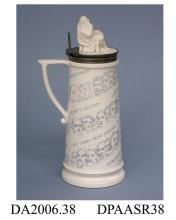
-
CeramicsInk bottle / BottleHMCMS:DA2002.63.2Ink bottle, salt-glazed stoneware, cylindrical with slightly cranked, squared-off neck; foot, impressed factory mark and registered design mark with encoded date of 28th December 1976, made by Doulton and Co, Lambeth, London, 1876+Visit Page
the item would have been registered under the amendment to the 1842 Act, allowing for the registration of non-ornamental designs
the registration date indicated in the mark does not tally with the original patent office records, which instead suggest that the design was registered on 28th March 1876 by Henry Stephens, the ink manufacturer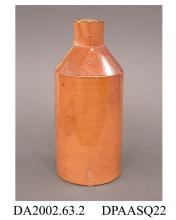
-
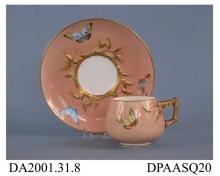
CeramicsCoffee cup and saucer / SaucerHMCMS:DA2001.31.8Coffee cup and saucer, bone china, coupe shape, with simulated bamboo handle, decorated with relief moulded bamboo and a solid salmon-colour ground with painted butterflies and gilt details; both components, painted pattern number C/8839 and printed registered design mark with encoded date of 6th October 1873, made by T C Brown-Westhead, Moore and Co, Hanley, Staffordshire, 1873+Visit Page
-
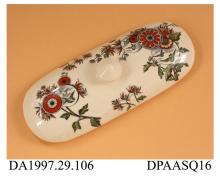
CeramicsToothbrush boxHMCMS:DA1997.29.106Toothbrush box, lid only, cream-coloured earthenware, decorated with 'Overton' pattern, printed and enamelled sprays of chrysanthemums, the flowerheads overlapping circular fans depicting birds in flight; underside, printed factory mark, pattern name and registered design mark with encoded date of 19th July 1883, made by George Jones and Sons, Trent Pottery, Stoke-on-Trent, Staffordshire, 1883+Visit Page
-
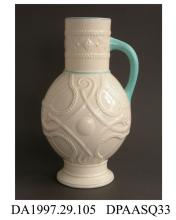
CeramicsJug / Ewer / Toilet setHMCMS:DA1997.29.105Jug, from a toilet set, the basin missing, cream-coloured earthenware, decorated with 'Celtic' design, relief-moulded interlaced serpents, plaited borders forming an equal-armed cross, bosses and other Celtic Revival motifs; base, painted pattern number 9785, printed factory mark and registered design mark with encoded date of 9th March 1878 impressed on a raised tablet, made by Powell, Bishop and Stonier, Hanley, Stoke-on-Trent, Staffordshire, 1880+Visit Page
the design was registered by Powell and Bishop in 1878; however, the seated chinaman mark found here was introduced by the company's successors, Powell, Bishop and Stonier in 1880