You searched for: All
Results: 17469
Filter search results
-
CeramicsTea cup and saucer / SaucerHMCMS:DA1997.29.16Tea cup and saucer, stone china, ogee profile cup with turned pedestal foot and loop handle, decorated with printed and enamelled 'Bohemia' pattern of flower sprigs, gothic diaper panels and iron lustre borders; printed registered design mark with encoded date of 22nd November 1844 on both components, with additional mark on saucer incorporating pattern name and proprietary name of body, made by Thomas Dimmock and Co, Albion and Tontine Streets, Hanley, Stoke-on-Trent, Staffordshire, 1844+Visit Page
the name 'Kaolin Ware' probably indicates that china clay has been added to the body for strength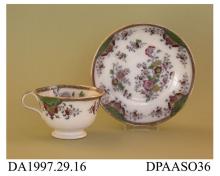
-
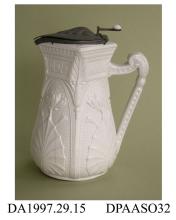
CeramicsJugHMCMS:DA1997.29.15Jug, white stoneware, slightly mottled smear glaze, square-topped pear shape, harp-shaped handle and hinged pewter lid, decorated with relief-moulded Egyptian motifs, including lotus on a textured ground representing water; base, impressed factory mark, 3 gill capacity mark (i.e. 15 fl. oz.), 24s (denoting the number accommodated in the batch) and registered design mark with encoded date of 2nd July 1877 impressed on an applied pad, made by W T Copeland and Sons, Spode Works, Stoke-on-Trent, Staffordshire, 1877+Visit Page
-
CeramicsCream jug / JugHMCMS:DA1997.29.14Cream jug, white feldspathic stoneware, smear-glazed, decorated with 'Nile' pattern, relief-moulded neo-classical borders on a stippled ground; base, moulded pattern name, factory mark and registered design mark with encoded date of 10th June 1870, made by William Brownfield, Cobridge, Stoke-on-Trent, Staffordshire, 1870+Visit Page
the mixture of an Egyptian name and predominantly Greek decorative elements may be traceable to Greek influence in the latter period of pharaohnic Egyptian history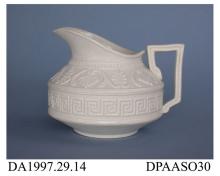
-
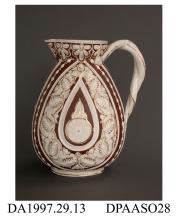
CeramicsJugHMCMS:DA1997.29.13Jug, white feldspathic stoneware, pear shaped, with handle in the form of intertwined snakes, vitreous glaze inside and on details outside, 'Cashmere' pattern, a brown background with relief-moulded traditional Indian and Hindu motifs; base, painted pattern number 286, moulded factory mark, pattern name and registered design mark with encoded date of 15th March 1867, made by William Brownfield, Cobridge, Stoke-on-Trent, Staffordshire, 1867+Visit Page
-
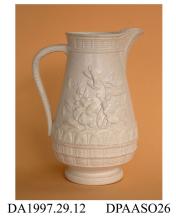
CeramicsJugHMCMS:DA1997.29.12Jug, white stoneware, mottled smear glaze, decorated with a relief-moulded design of pansies growing behind a low arcaded fence; base, impressed factory mark, figure 18 and registered design mark with encoded date of 13th February 1864 impressed on an applied pad, made by W T Copeland, Spode Works, Stoke-on-Trent, Staffordshire, 1864+Visit Page
-
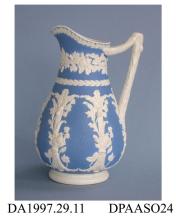
CeramicsJugHMCMS:DA1997.29.11Jug, white stoneware, vitreous glaze inside, smear-glazed outside, relief-moulded 'Union' pattern, assemblages of roses, thistles and shamrocks, the emblems of the United Kingdom, against a painted blue slip background; base, moulded factory mark in the form of a Staffordshire knot, and pattern name and registered design mark with encoded date of 4th December 1861, both apparently impressed on applied pads, made by William Brownfield, Cobridge, Stoke-on-Trent, Staffordshire, 1861+Visit Page
the pattern name, Union, and its subject of UK national symbols was probably inspired by the 60th anniversary of the implementation of the act to create the United Kingdom of Great Britain and Ireland on 1st January 1801